A screenshot has always been a persuasive little artifact. It feels like a receipt: proof that someone said something, agreed to something, threatened something, promised something. For years that feeling was mostly justified. Screenshots could be cropped, yes, or annotated, yes, but the core image generally anchored to a real screen at a real moment.
That assumption is collapsing in 2026. Not because people suddenly became more deceptive, but because the tools became frictionless. And because the social and legal systems around screenshots still treat them as if they were inherently harder to fake than they actually are.
From “share” to “fabricate” in under a minute
The modern screenshot is no longer just an output. It is a format, a template, a storytelling device. Fake conversation builders make that explicit: pick a platform skin, choose names and avatars, type the lines, export. The result looks like the artifact we have been trained to trust, even though it is closer to graphic design than documentation.
One reason this shift matters is scale. A single forged chat screenshot can be produced faster than it can be refuted, and it can spread far beyond the reach of any later correction. A forged exchange need not be perfect to be effective; it just needs to be plausible at a glance. People scroll quickly. They respond emotionally. They often read the caption before the image, then interpret the image to match.
This is not theoretical. Anyone can open a generator, select WhatsApp styling, and create a “conversation” that fits a narrative beat, including typing indicators and timestamps. A search for a whatsapp chat screenshot generator illustrates the point: the design language of major platforms has become a set of skins that can be applied to fiction as easily as to parody.
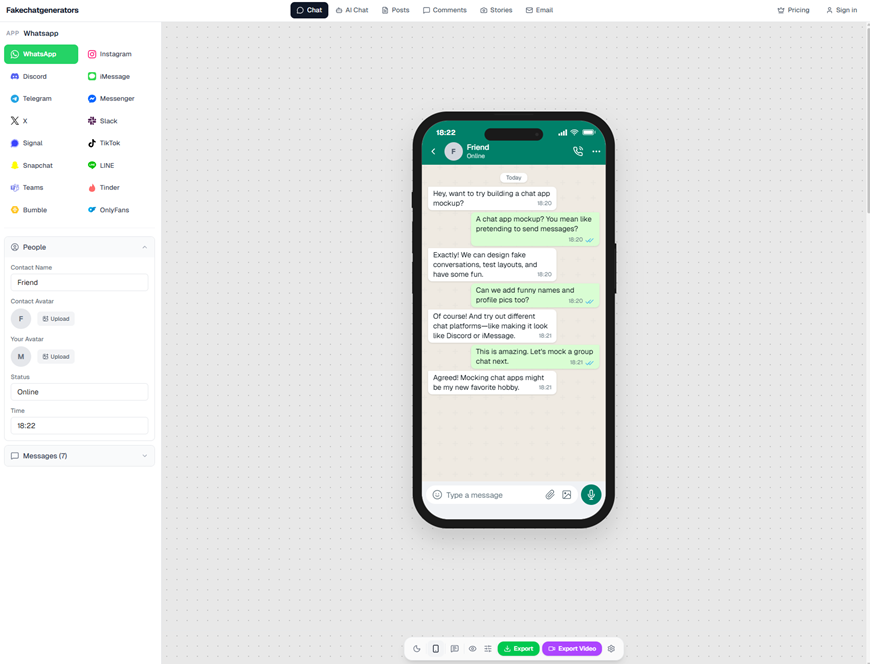
fakechatgenerators.com lets you mock up chat screenshots across 16 platforms
The same ecosystem that powers jokes and skits can also power harassment, extortion, and reputational sabotage. The tool is neutral. The outcomes are not.
Why screenshots work as weapons
Screenshot forgery thrives because it exploits three human instincts:
- The screenshot-as-receipt instinct. We treat an image of a conversation as a captured event rather than a constructed artifact.
- The “it looks right” shortcut. If the font, bubbles, and timestamps feel familiar, most viewers do not pause to ask about provenance.
- The moral drama bias. Screenshots tend to be shared when they imply betrayal, hypocrisy, or wrongdoing. Those are the stories people repeat.
In 2026, this combination is particularly volatile because screenshots sit at the intersection of private life and public dispute. They show names, faces, handles, and contexts. They can implicate someone without giving that person the chance to explain. And they can be tailored: a forged screenshot can be calibrated to match the target’s writing style, the group’s inside jokes, the exact platform where the target is known to communicate.
Add one more factor: the screenshot has become a court-adjacent object. Even when it is not formally admissible, it shapes negotiations, HR decisions, school discipline, and workplace investigations. “We have screenshots” has become a shorthand for “we have proof.” Too often, that ends the conversation.
The new forgery stack: generators, edits, and AI polish
It is tempting to imagine screenshot forgery as a single technique, but in practice it is a stack. In 2026, the most convincing fakes are rarely produced by one method alone.
1) Template-level fabrication
Generators replicate UI patterns and platform aesthetics. They can produce consistent spacing, icons, and conversation structure. This is enough for many use cases, particularly when the image is viewed on mobile and compressed by social platforms.
2) Manual image editing
A basic editor can change a name, time, battery icon, or a message line. Manual edits can also remove clues. For example, an inconsistent status bar or a telltale edge around text can be smoothed away. Editing also allows a forger to blend a real screenshot with a forged addition, which is often more believable than a fully synthetic conversation.
3) AI-assisted “repair”
Generative fill and enhancement tools can clean seams, re-render text, and add plausible noise patterns. This is the part that makes forensic intuition less reliable. Many people can spot a sloppy Photoshop job. Far fewer can spot a clean one that has been polished by a model trained to make artifacts disappear.
The consequence is grimly practical: as the quality floor rises, the burden shifts to defenders. It is no longer enough to say “that looks fake.” People want to know how you know, and whether you can prove it.
What’s really at stake: authenticity as infrastructure
When screenshot forgery becomes common, it harms more than individual targets. It erodes the usefulness of screenshots in legitimate contexts.
Consider a few everyday scenarios:
- Journalism: A tip arrives with screenshots of an official speaking carelessly. Publishing the claim could be defamatory. Ignoring it could miss a genuine scandal. Verification becomes slower and more expensive.
- Workplace investigations: HR receives screenshots alleging harassment. If the images are forged, an innocent person could be disciplined or fired. If they are real but dismissed as “probably fake,” a victim may be left unprotected.
- Marketplaces and banking: Support teams handle disputes where screenshots are offered as evidence of payment, authorization, or account activity. Fraudsters know that screenshots can be persuasive to a hurried reviewer.
- Courts and legal prep: Even if a screenshot is not admitted as evidence, it can influence settlement talks, restraining order decisions, or reputational leverage.
This is why authenticity is infrastructure. Once the baseline trust in everyday evidence collapses, institutions either become cynical (“nothing is trustworthy”) or vulnerable (“it looks real enough”). Neither is acceptable.
The limits of human verification
A common response to forged screenshots is to recommend “common sense” checks: look for inconsistent fonts, weird spacing, mismatched timestamps, odd battery percentages, or unnatural language. Those checks still matter. They are also increasingly insufficient.
Three reasons:
- Compression destroys clues. Platforms re-encode images. Artifacts that might signal manipulation get blurred into the mush of normal compression.
- UI variation is normal. Dark mode, accessibility settings, different OS versions, and regional formats create legitimate differences that can be mistaken for forgery, or used to excuse it.
- Viewers are biased. People scrutinize screenshots they dislike and accept screenshots they want to believe. That is not a moral failing. It is a predictable cognitive pattern.
Human review is also expensive. It takes time, attention, and experience. Most organizations do not have enough of any of those to treat every screenshot as a mini forensic investigation.
Why detection has to be probabilistic, and fast
If screenshot forgery is scaling, verification must scale too. That does not mean replacing human judgment. It means giving human reviewers tools that can triage, flag, and prioritize.
That is where AI-based detection enters, not as a magic oracle, but as a practical layer in a broader workflow. The goal is not to declare truth with a single score. The goal is to identify images that merit deeper scrutiny, and to catch the easy wins: synthetic media, tampered documents, and edits that slip past casual inspection.
Speed matters here. Trust and safety teams operate in queues. Banks and marketplaces operate in real time. Newsrooms operate on deadlines. If an authenticity check takes seconds rather than minutes, it can be embedded into normal operations instead of becoming a special procedure reserved for the biggest cases.
A tool such as an ai image detector positions itself for this reality by emphasizing operational metrics: claims of 98.7% detection accuracy across more than 50 generative models (including Midjourney, DALL-E, Stable Diffusion, Flux, Ideogram, Google Gemini, and GANs), sub-150ms latency, and coverage beyond “AI or not” into NSFW, violence, and document tampering. Even if one treats any vendor claim as something to validate internally, the direction is clear. Detection is becoming less like artisanal forensics and more like a standard control, similar to spam filtering.
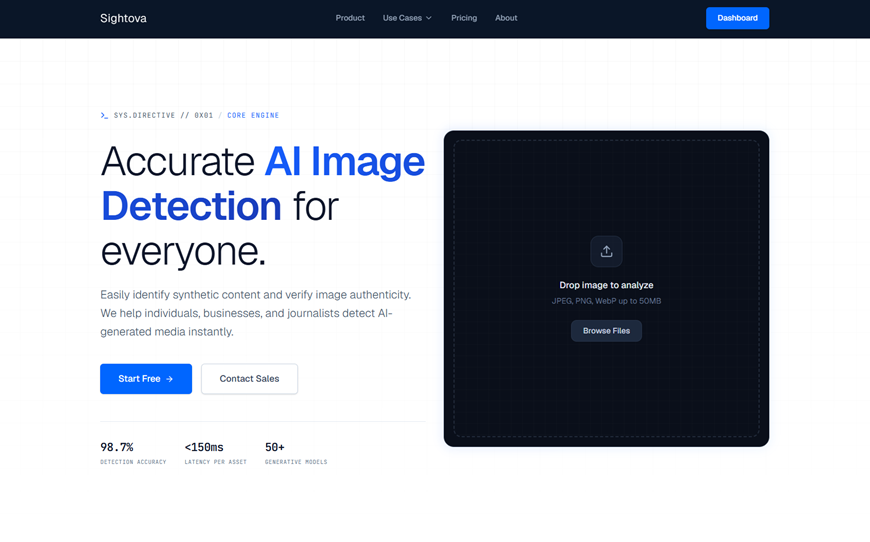
sightova.com flags AI-generated, tampered, NSFW, and violent imagery in milliseconds
Screenshot forgery is not only “AI-generated,” and that matters
A subtle but important point: many forged screenshots are not generated end-to-end by a model. They are composed. A generator provides the UI shell. Manual edits add specificity. AI tools remove seams. The final image may contain real elements and synthetic elements interleaved.
Detection systems therefore need to look beyond the simplest framing of “AI-generated image” versus “real photo.” Screenshot forgery often lives in the gray area of document tampering, UI replication, and compositing. In practice, the question is: Has this image been manipulated in a way that changes meaning? That is closer to integrity analysis than to aesthetic classification.
For organizations, this has implications for how they interpret outputs. A detector might flag “tampering” rather than “AI.” That is still valuable. In a screenshot dispute, the manipulation method is less important than the presence of manipulation.
Where the risk concentrates in 2026
Not every screenshot carries the same risk. The most damaging fakes cluster around a few themes:
Reputational sabotage
A forged DM exchange can imply racism, infidelity, abuse, bribery, or betrayal. It can be tailored to a workplace context or a community conflict. Once the target responds, the screenshot gains a second life: “Look, they’re denying it.”
Financial fraud
Payment confirmations, account notifications, customer support chats, and delivery proofs are frequently used in scams. Fraudsters exploit the fact that many teams still accept screenshots as supporting evidence, especially when the transaction amount is small and the goal is to resolve quickly.
Harassment and coercion
Screenshots can be used as leverage, even if the recipient doubts their authenticity. The threat is often social rather than legal: “I will send this to your employer,” “I will post this.” The emotional impact does not require the screenshot to be real. It requires it to be believable to someone else.
Institutional disputes
Schools, workplaces, and volunteer communities regularly arbitrate conflicts with incomplete information. Screenshots become the de facto record. Forgery turns these settings into easy targets because they often lack formal evidence-handling procedures.
What a serious verification workflow looks like
Organizations that rely on screenshot evidence need a layered approach. Detection tools can help, but they should be one element in a defensible process.
A robust workflow typically includes:
- Provenance request: Ask for the original file, not a re-upload. Re-uploads strip metadata and introduce compression. If possible, ask for a screen recording that includes opening the relevant app and navigating to the conversation.
- Context capture: Collect surrounding messages, not just the “smoking gun” line. Forgers often provide only the minimal crop that supports their claim.
- Cross-validation: Where lawful and appropriate, corroborate with server-side logs, account records, or participant confirmation. Screenshots should not be the sole source of truth for high-stakes outcomes.
- Automated triage: Run images through detection for AI generation signals, tampering indicators, and document integrity issues, then route flagged items for deeper review.
- Human adjudication: A trained reviewer considers the full context, including incentives and inconsistencies, and documents the rationale for decisions.
This is not bureaucracy for its own sake. It is the minimum required to avoid making irreversible decisions based on a picture that might have been assembled in a bedroom in five minutes.
The uncomfortable social consequence: plausible deniability for real screenshots
There is an irony here. As forgeries become more common, genuine screenshots lose persuasive power. Wrongdoers can dismiss authentic evidence as “AI.” Victims can be doubted. Investigators can hesitate.
This is another reason detection matters. When authenticity is routinely questioned, the ability to validate genuine material becomes as important as the ability to flag fake material. Detection, done well, supports both outcomes: it reduces false accusations and it strengthens legitimate claims.
What to watch next
Screenshot forgery will keep improving, but the more meaningful changes are procedural and institutional.
- Platform design: Messaging apps may move toward cryptographic verification of exported conversations, or include verifiable “share” formats that preserve integrity. If they do, adoption will be slow and uneven.
- Policy: Courts, employers, and schools will formalize standards for when screenshots can be used, what corroboration is required, and how disputes are handled.
- Tooling convergence: Authenticity checks will blend with content moderation, fraud prevention, and document verification. The organizations that treat these as separate problems will miss how attackers combine them.
The headline in 2026 is not that screenshots can be faked. They always could be. The change is that forging them is now so easy, and so scalable, that screenshots can no longer be treated as self-authenticating evidence. The responsible response is not paranoia. It is process, plus fast, competent detection that fits into real workflows.
Trust will not return because we wish for it. It will return when we can justify it.